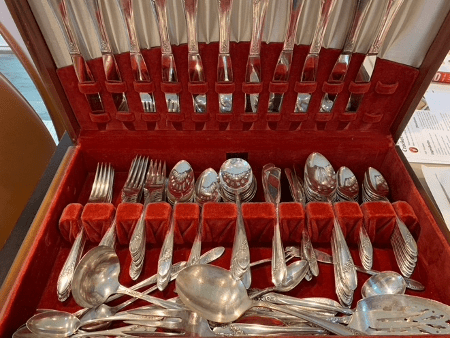
When we had to shrink my mom’s world for her move into assisted living, one of the things I inherited was her mother’s set of silverplate flatware, service for 12. My dismissive first look judged the flatware’s design not to my sophisticated taste. So, the wooden chest with rows of precisely formed, red-velvet-lined slots, one for each group, was tucked away on a sideboard shelf under a pile of placemats. I asked siblings and cousins if they had any interest in the set. No takers. Collecting special China, crystal, and silver wasn’t a thing anymore. It sure wasn’t my style, and I knew very little about the traditions. Relics of the past, like so many memories.
Mom’s mother was my Gramma Pesz. She was my refuge during the reign of Sir Lie-a-lot, our first stepdad. I escaped home to spend many weekends in her downtown Everett apartment. That time in her gentle presence did much to inform my creative sensibilities. For her church’s missions in Africa, we sewed children’s clothing, pieced together from mismatched donated fabric. We made scrapbooks for the missions, too, collage pages with images cut out from used greeting cards. We toddled together down the block to her church for choir practice where there was always a cantata in rehearsal.
Recently a local artist and neighbor who creates art from found materials, posted a request for used silverware. I thought of Gramma Pesz’s set, unused for decades, and offered it. But what did I know about these relics we’d held for so long, patiently waiting in their storage chest? Should I do a little research to ensure I wasn’t giving away a rare collectible—something worth more than I realized?
Over the next few days, I filled hours in a deep dive down internet rabbit holes. The antique wooden chest had a small, gilded label attached to the red velvet lining behind the stack of cream soup spoons. Of course, I didn’t yet know these were spoons made specially for cream soups. That was one of my later discoveries. But that label gave me a starting point. Browsing through page after page of Rogers Bros 1847 silver patterns I found no match. Hmmm, where to find another clue? As I said, I know little about these traditions. Glaringly obvious, once discovered, was that the back of each piece is marked with the manufacturer and collection name. Mine was Oneida Tudor Plate, not Rogers Bros after all. She’d apparently acquired the wooden storage chest separately.
There is so much about my grandmother’s life that I didn’t appreciate until years later. She obviously was a brave woman, becoming Margaret Pesznecker when she married after growing up as Margaret Smith. My earliest memories of her are at a farm east of downtown Vancouver, Washington, on land long-since covered by miles of suburban homes and Interstate 205. My mom describes an idyllic childhood there, with three older brothers who invented all sorts of adventures in the fields and surrounding woods. Everyone helped in the barn and with haying. Summers were busy canning and freezing the bounty from Gramma’s kitchen garden, where of course weeding, watering, and harvesting were among the kids’ many chores.
Why would Gramma Pesz have a silver service for twelve? How could this frugal farm wife even afford it? Gramma and Grampa weren’t known for entertaining. Yet, more research helped me identify specialty pieces that you’d never find in a modern flatware set. We had a jelly server, a master butter server as well as individual butter spreaders, soup spoons with shapes designed specifically for cream soups, and others to be used only with broths, then iced tea spoons and pickle forks, cake servers, ladles, and more.
Oneida’s Queen Bess silverplate was introduced in 1946. It’s probably the best-known Tudor Silverplate pattern, a floral flourish inspired by garden roses that was described at the time as “simple enough to go with anything, modern or traditional, yet has grace and distinction.” My mom confirmed that Gramma had started this collection soon after it was introduced as a Betty Crocker premium. Thousands of housewives around the country spent the late 1940s and early ’50s clipping Betty Crocker coupons from boxes of select General Mills products and sending them in, along with a little money, to gradually build their Queen Bess sets. I picture Gramma sitting at her kitchen table, an envelope of neatly organized coupons, carefully choosing her next acquisition in the slow process of collecting full service for 12, as well as those specialty serving pieces. This was something to look forward to, something precious she could bring into her humble farm home.
Grampa Pesz’s family had emigrated from Germany to Hungary in the 1890s, then to America in 1903, hoping to avoid being caught up in war. He wasn’t much of a talker, more of a doer. On the Vancouver farm, he worked hard raising brood hens.
I was a little shy of his gruff demeanor. You knew he held everyone, including himself, to very high standards. During WWII, my oldest uncle was drafted into the Army where he spent time as a German POW. My mom says that’s the only time she ever saw her dad cry. Later in their lives, times got tough and Grampa needed help keeping the farm going. On the drive home from a meeting with Portland bankers, his car veered into a bridge support. He didn’t make it home to tell Gramma that their loan request had been denied.
About that same time, my newly divorced single mom of three moved us from Aberdeen to the Seattle area. We needed to be closer to her brothers and their families who were all there by then. It also made sense for Gramma to leave the farm behind and move in with us.
How lucky we were to have her there, after-school treats at the ready every day, to have her care for us when Mom worked late or on rare occasions went out on her own. She expanded our collection of home-sewn dress-up outfits, taught us card games, played endless rounds of Sorry, and always beat me at Scrabble while helping me learn the strategic value of odd two- and three-letter words such as qi, jo, raj.
We were just old enough to stay home alone after school, at least by standards of the time, when Mom brought Sir Lie-a-lot into our lives. Gramma opted to move to an Everett apartment, close to her favorite pastor who’d relocated there. I missed Gramma’s everyday presence, but we stayed close, enjoying those weekend escapes to her apartment, sewing, cooking, and listening to classical music. Her favorite was trumpet, mine piano.
After a few years, Mom finally got Sir Lie-a-lot out of our lives and we landed in an apartment complex where we met Richard the Kindhearted, who became our new stepdad. I no longer needed those weekend escapes to Everett. Instead, we’d drive up to her little apartment and bring Gramma down to Seattle for the day and a meal with our newly blended family. As time went by, high school study and a tight-knit group of friends filled my days.
When I eventually moved to Pullman to finish college at WSU, I was completely absorbed adjusting to life on my own, making new friends, figuring out how to become an adult. I’m sure I wrote letters and sent cards, but I don’t recall taking the time to visit Gramma for far too long. Everyone’s life was complicated and changing. By then, she lived in a senior care facility. All but a handful of her lifetime’s belongings divided among Mom, who got the silverplate, and my three uncles.
Oddly enough, a few months after I relocated to Pullman, so did Mom and Richard, where he had a new job with a large farming operation. After we moved away, Gramma withered. Within a few months, she passed in her sleep. Mom is sure Gramma just gave up, willing herself to die. Her heart ached over that for a long time.
The perspective that aging brings is a curious thing. No way to learn or share it without doing the time. I often think back on the choices I’ve made, both bad and good, and where each one led me. One regret is that I may not have made sure Gramma knew just how much she meant to me. As I uncovered the history of her silver, it became a symbol of her presence in my life. Precious, unseen for a time, then newly cherished. Thinking about her while writing this story helped me recover wonderful memories. And I am so very lucky that my mom is still here to share her memories and perspectives. Her advice, to learn from the outcomes of your decisions and then go on, helped diminish my regret. I appreciate that Gramma’s influence has been a guiding force all my life.
This silver set had little significance to me and sat in a cupboard for years. When I finally brought it into the light, it took on a meaning that I couldn’t have imagined. I had found rare collectibles worth much more than I realized. Now I’m ready to let the silver service go. My mom and I can’t wait to see it become art.|

 Left To Write